
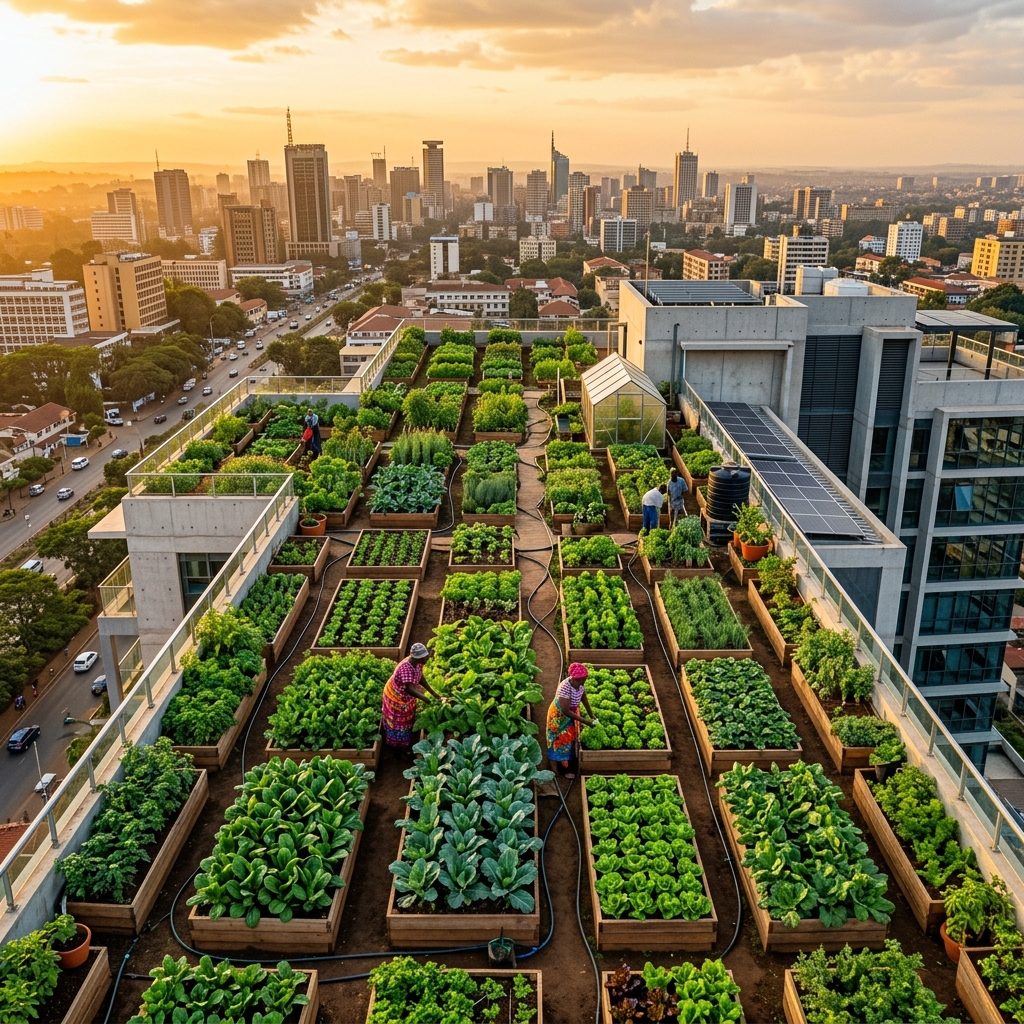
Africa's cities are growing faster than anywhere else on earth. By 2050, over 60% of the continent's population will live in urban centres. The question of how to feed them — affordably, nutritiously, sustainably — is one of the defining challenges of our generation. At BOS, we believe the answer is right above our heads.
Why Rooftops?
In dense urban environments, horizontal space is expensive and scarce. But vertical space — particularly the flat or gently sloping rooftops of concrete city buildings — remains almost entirely unused. A standard 3-bedroom house in Kampala, Nairobi, or Accra has a rooftop of 50–120 m². Our community trials show that even 20 m² of well-managed rooftop garden can produce enough vegetables for a family of five every week.
Beyond food production, rooftop gardens deliver remarkable secondary benefits: they reduce indoor temperatures by up to 4°C (cutting cooling costs), slow stormwater runoff that would otherwise cause flooding, improve air quality, and dramatically reduce a household's food budget.
The BOS Rooftop System
Our Smart Village urban farming system is built around four principles: lightweight, affordable, productive, and organic. Instead of heavy soil beds that would overload most rooftops, we use:
- layersGrow bags filled with composted coir and vermicompost — lightweight, reusable bags filled with a custom blend of coconut coir (very light), local vermicompost, and biochar. Each bag weighs only 4–5 kg when planted versus 20+ kg for soil equivalents.
- water_dropDrip irrigation from rainwater harvesting tanks — a simple gravity-fed drip system connected to rooftop rain catchment tanks eliminates the need for mains water. One 500L tank sustains a 20 m² rooftop garden through a typical dry spell.
- scienceFermented plant juice foliar sprays — instead of synthetic fertilizers, plants are fed with fermented sprays made from local weeds, banana peels, and wood ash. These stimulate plant immunity and dramatically improve yields.
- hubCompanion planting for pest control — strategic combinations of basil, marigold, and chilli around vegetable beds deter pests naturally, eliminating the need for pesticides that contaminate produce and harm pollinators.
"I started a rooftop garden after learning from BOS. Now I supply vegetables to 15 families in my building every week. My children eat fresh food every day and I save 40,000 UGX on groceries every month."
— Amara Diallo, Urban Farmer, Accra
What Can You Grow?
Almost anything. Our recommended starter selection for East African urban rooftops includes: kale, spinach, amaranth, tomatoes, green peppers, spring onions, herbs (basil, coriander, rosemary), climbing beans, and sweet potatoes. All of these thrive in grow bags with 6–8 hours of direct sunlight and weekly foliar feeding.
In year two, once you have mastered the basics, BOS participants begin integrating dwarf fruit trees in large containers — papaya, lemon, and passion fruit are favourites — which add shade, food, and beauty to the rooftop environment.
Joining the Urban Farming Revolution
BOS Community Village hubs run monthly Urban Rooftop Farming workshops in Kampala, Nairobi, and Accra. Participants receive a starter kit including grow bags, seeds, and a basic drip irrigation set. Online follow-up sessions every two weeks keep farmers connected and troubleshoot challenges in real time.
The city is not the enemy of nature. With the right knowledge, every urban rooftop becomes a small ecosystem — a miniature farm that feeds families, cools buildings, and reconnects city dwellers to the miracle of growing their own food. Visit our Community Villages Hub to find a workshop near you.